
7QC Tools — Pareto Analysis
Pareto Analysis – Identify the Vital Few That Drive Most of Your Losses
Use structured data prioritisation to focus improvement efforts where impact is highest.
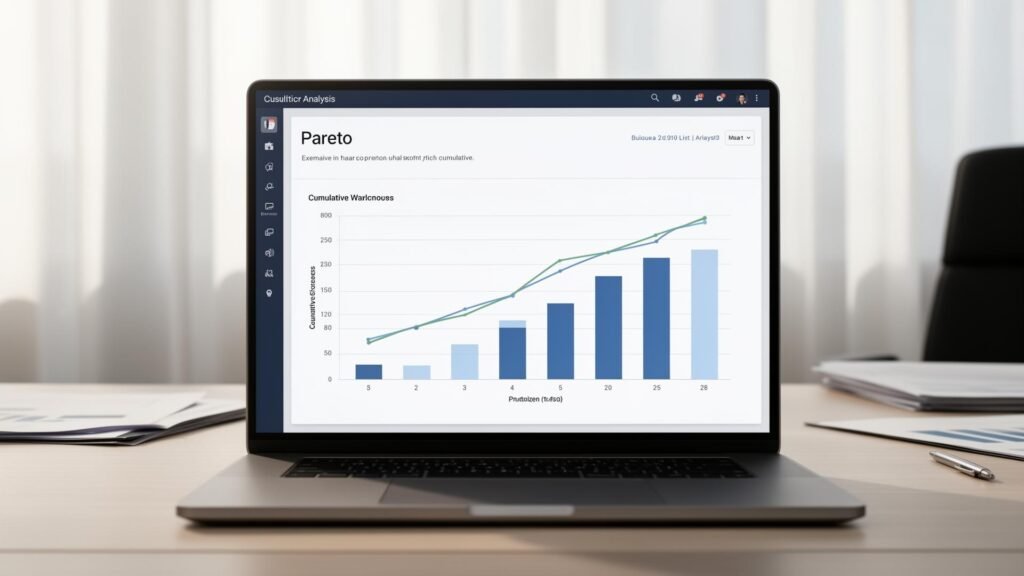
Too Many Problems. No Clear Focus.
Organisations often spread their resources across dozens of issues — solving none decisively. Pareto brings clarity.
Multiple recurring defects with no clear root cause
Repeated customer complaints across categories
Downtime spread across many equipment types
Cost breakdown confusion across departments
Scattered improvement efforts with diluted results
The 80/20 Principle
20% of Causes → 80% of Impact
The Pareto Principle reveals that a small number of categories typically account for the majority of losses, defects, or complaints. By identifying these “vital few,” you direct resources where they matter most — achieving disproportionate improvement with focused effort.
Separates the vital few from the trivial many
Provides data-backed focus for decision-makers
Accelerates improvement cycle time
Reduces wasted effort on low-impact issues

Our Approach
Pareto Deployment Framework
A clear 5-step process from raw data to focused action.
01
Data Collection
Gather defect, complaint, or loss data systematically.
02
Categorization
Group issues into meaningful categories.
03
Quantification
Measure frequency, cost, or impact per category.
04
Chart Development
Build the Pareto chart — bars + cumulative line.
05
Action Prioritization
Focus resources on the vital few for maximum impact.
Business Impact
Measurable Results
Focused Improvement
efforts on vital few
Defect Rate Reduction
within first cycle
Faster Decisions
quicker root cause focus
COPQ Reduction
cost of poor quality
Integrated Approach
Pareto Feeds Into Lean & Six Sigma
Engagement Models
How We Engage
1–2 Day Workshop
Hands-on Pareto training with real data from your operations.
Data Analysis Report
We analyse your data and deliver a prioritised improvement report.
Executive Review
Strategic session with leadership to align priorities and resources.
Action Roadmap
End-to-end improvement plan based on Pareto findings.
Suitable For Every Industry
Pareto Analysis works wherever issues can be categorised and quantified.
Manufacturing
Service Operations
Healthcare
Logistics
IT & Software
Quality Departments
FAQs
Frequently Asked Questions
What is Pareto Analysis?
Pareto Analysis is a decision-making technique based on the 80/20 principle — it helps identify the small number of causes responsible for the majority of problems, enabling focused and high-impact improvement.
What data do we need for a Pareto study?
A focused Pareto diagnostic can be completed in 1–3 days depending on data availability and scope. We deliver actionable findings quickly.
How long does a Pareto diagnostic take?
Initial control chart setup for key processes can be completed in 2 to 4 weeks, including data collection and chart configuration. Full deployment with operator training and response protocols typically takes 4 to 8 weeks.
How is Pareto different from other quality tools?
Unlike tools that explore root causes (Fishbone) or track trends (Control Charts), Pareto is specifically designed for prioritisation — it tells you where to focus first for maximum impact.
Can Pareto be used in service industries?
Absolutely. Pareto applies to any domain — from customer complaint categories in banking to ticket types in IT support. Wherever issues can be categorised and quantified, Pareto works.
Does Pareto integrate with Six Sigma projects?
Yes. Pareto is a core tool within the DMAIC framework — used in the Measure and Analyze phases to prioritise defects and guide deeper investigation with Six Sigma tools.